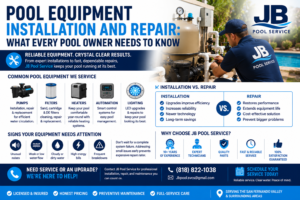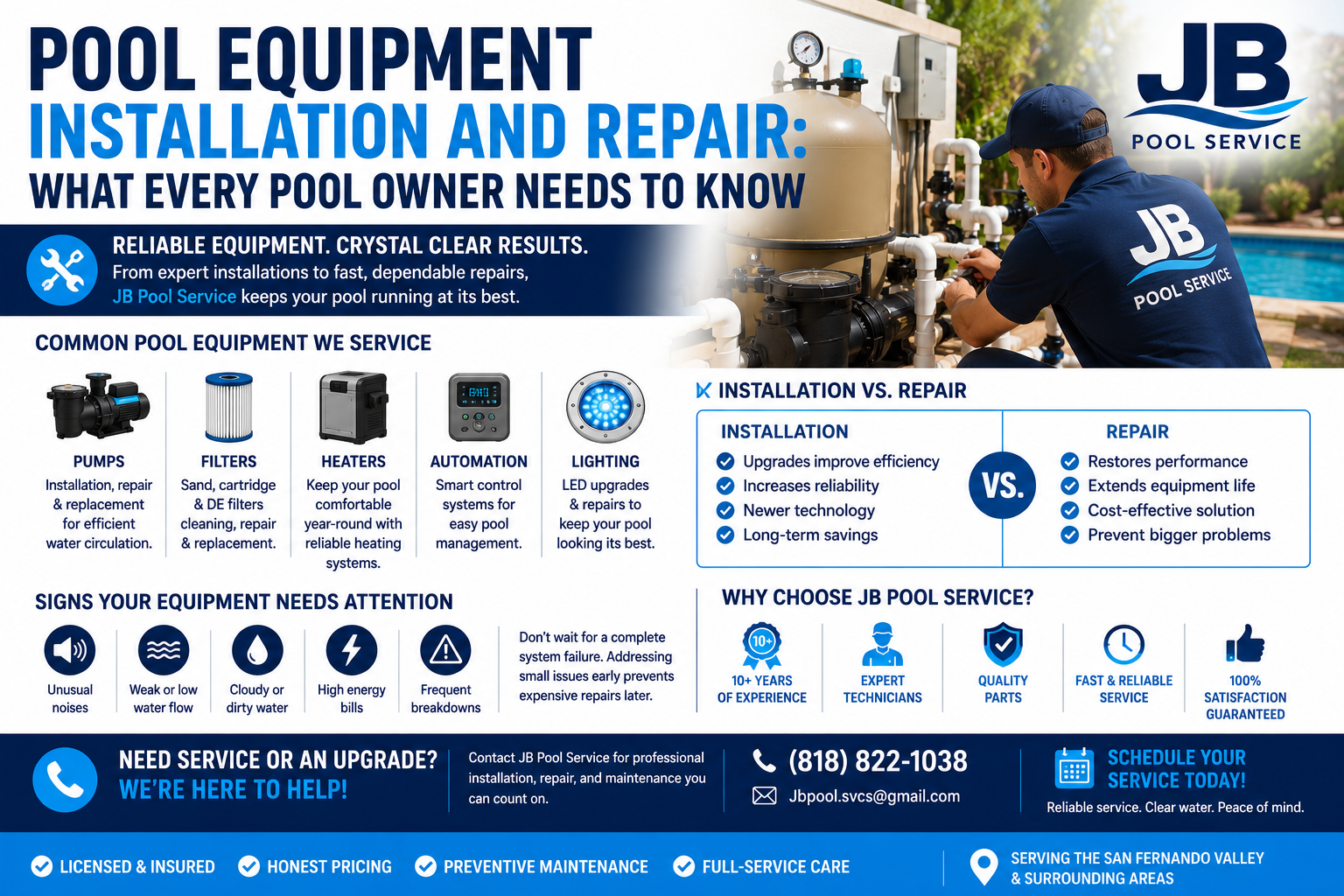
Your pool is only as good as the equipment running it. The pump, filter, heater, and automation systems that keep your water circulating, clean, and comfortable are working every single day — and like any mechanical system, they need proper installation, regular maintenance, and expert repair when something goes wrong.
At JB Pool Service, we’ve been installing and servicing pool equipment across Southern California since 2010. In this guide, we break down everything pool owners need to know about the key equipment that powers their pool, the signs that something’s going wrong, and how to make smart decisions about repair versus replacement.
Whether you’re building a new pool, upgrading aging equipment, or dealing with a pump that just stopped working, this guide has the answers.
The Core Equipment That Powers Your Pool
1. The Pool Pump — The Heart of the System
The pump is the single most important piece of equipment in your pool system. It circulates water through the filter, heater, and sanitizing systems, keeping everything moving and the water clean. A pool without a working pump is a pool that will go green — fast.
Types of pool pumps:
Single-speed pumps — The traditional standard. Runs at one fixed speed. Effective but energy-intensive, since they run at full power even when partial circulation would be sufficient.
Two-speed pumps — Can run at high or low speed, reducing energy consumption during off-peak circulation cycles.
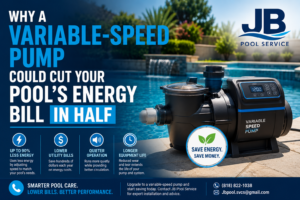
Variable-speed pumps (VSP) — The modern standard and the most energy-efficient option. Variable-speed pumps can run at precisely the flow rate needed for each function (filtration, heating, spa jets, etc.), dramatically reducing energy costs. In many cases, a variable-speed pump pays for itself in energy savings within 2–3 years. Many states and utilities now mandate or incentivize variable-speed pumps.
Signs your pump needs attention:
- Pump makes unusual noises — humming, grinding, or screeching
- Reduced water flow or weak return jets
- Pump runs but water isn’t circulating
- Pump trips the circuit breaker
- Visible leaks around the pump housing or fittings
- Pump fails to prime (runs dry)
When to repair vs. replace: Seal replacements, impeller cleaning, and basket repairs are cost-effective pump repairs. If the motor has failed and the pump is older than 8–10 years, replacement — ideally with a variable-speed model — is usually the smarter investment.
2. The Pool Filter — Keeping Water Clear
The filter removes particles, debris, and contaminants from your pool water. It works in constant partnership with the pump — water flows from the pump through the filter before returning to the pool. A properly functioning filter is essential for clear, healthy water.
The three main filter types:
Sand Filters — Use specially graded silica sand to trap particles. Require periodic backwashing to clean. Simple, durable, and effective for most pools. Sand needs to be replaced every 5–7 years.
Diatomaceous Earth (DE) Filters — Use fossilized diatom powder as the filtering medium. Provide the finest filtration of the three types, removing particles as small as 2–5 microns. Require regular backwashing and recharging with DE powder. More maintenance-intensive but superior filtration quality.
Cartridge Filters — Use pleated polyester cartridges that are removed and rinsed clean. No backwashing required. Excellent filtration, lower water waste, and easy maintenance. Cartridges need replacement every 1–3 years depending on use.
Signs your filter needs attention:
- Pool water is persistently cloudy despite proper chemistry
- Filter pressure gauge reads higher than normal (dirty filter)
- Visible DE powder or sand returning to the pool through the jets
- Filter is leaking
- Shortened backwash cycles in sand/DE filters
Choosing the right filter: The right filter for your pool depends on its size, use, and your preferences for maintenance. JB Pool Service can assess your current setup and recommend the optimal filter system for your specific situation.
3. The Pool Heater — Extending Your Swim Season
A pool heater extends your usable swim season significantly — in Southern California, a well-sized heater can mean year-round swimming. There are three main types:
Gas heaters (natural gas or propane) — Heat water quickly, regardless of outside temperature. Ideal for pools that aren’t heated continuously or that need rapid temperature changes (vacation homes, pools that are used intermittently). Higher operating costs than heat pumps but faster heat recovery.
Heat pump heaters — Use electricity to extract heat from the ambient air and transfer it to the pool water. Extremely efficient in moderate climates — using 5–6 units of heat for every unit of electricity consumed. Lower operating costs than gas but slower to heat and less effective in cold weather (below 50°F). Southern California’s mild climate makes heat pumps a smart choice for many homeowners.
Solar heaters — Use solar collectors, usually roof-mounted, to heat water directly. Zero operating cost once installed. Work best in sun-rich climates (Southern California is ideal) and for pools that don’t need heating in winter. Often used in combination with a gas heater or heat pump for maximum efficiency.
Signs your heater needs attention:
- Pool isn’t reaching target temperature despite running
- Heater fires but shuts off quickly (short cycling)
- Error codes or warning lights on the control panel
- Visible corrosion or scale on the heat exchanger
- Gas heater smells like gas — turn off immediately and call a professional
- Unusual sounds from the heater
Heater maintenance tip: Scale buildup inside the heat exchanger is the most common cause of heater efficiency loss and premature failure. Annual inspection and descaling extends heater life significantly. JB Pool Service includes heater inspection as part of our equipment service offerings.
4. Pool Automation Systems — Control at Your Fingertips
Modern pool automation systems let you control your pump, heater, lights, water features, and more from a smartphone app or wall-mounted control panel. What used to require walking to the equipment pad and manually adjusting timers and settings can now happen from anywhere.
Benefits of pool automation:
- Schedule pump run times for off-peak electricity hours
- Monitor and adjust water temperature remotely
- Control spa jets, water features, and lighting from your phone
- Receive alerts when equipment malfunctions
- Integrate with smart home systems
- Reduce energy costs through intelligent scheduling
Popular automation brands we work with include Pentair IntelliConnect, Hayward OmniLogic, and Jandy iAqualink — all of which offer robust app-based control and integration with variable-speed pumps.
Upgrading to automation: If your pool still runs on manual timers and analog controls, the upgrade to a modern automation system is one of the most impactful improvements you can make. Installation costs vary by system complexity, but the convenience, energy savings, and peace of mind make it a highly popular upgrade among homeowners we serve.
5. Salt Chlorine Generators — Softer Water, Less Hassle
Salt chlorine generators (also called salt systems or saltwater systems) convert dissolved salt in the pool water into chlorine through electrolysis. The result is a pool that sanitizes itself continuously, producing fresh chlorine on demand without the need to manually add chlorine tablets or liquid chlorine.
Benefits of salt systems:
- Softer, gentler water that’s easier on eyes and skin
- Consistent chlorine production without manual dosing
- Lower ongoing chemical costs
- Reduced chloramine buildup (the compound responsible for that “pool smell” and eye irritation)
Misconceptions: A saltwater pool is not chlorine-free. It produces chlorine — just continuously and automatically. The salt concentration (typically 2,700–3,400 ppm) is much lower than ocean water and is barely perceptible to most swimmers.
Maintenance needs: Salt cells need periodic cleaning (every 3–6 months) and replacement every 3–7 years depending on the brand and water chemistry management. Annual inspection of the cell and control board helps maximize system life.
Pool Equipment Installation: What to Expect from JB Pool Service
Whether you’re equipping a new pool from scratch or replacing aging equipment on an existing pool, proper installation is critical. Equipment installed incorrectly doesn’t just underperform — it can fail prematurely, void warranties, and in some cases create safety hazards.
What JB Pool Service handles:
- Variable-speed pump installation and programming
- Filter installation (sand, DE, and cartridge)
- Gas heater and heat pump installation
- Salt chlorine generator installation and commissioning
- Pool automation system installation and setup
- LED pool lighting installation
- Water feature equipment installation
Every installation is performed by experienced technicians, properly permitted where required, and tested before we sign off. We also walk you through the operation of any new equipment so you know exactly how to use it.
Pool Equipment Repair: Common Issues We Fix
Even well-maintained equipment eventually needs repair. Here are the most common equipment issues we handle:
Pump repairs: Seal replacements, impeller cleaning, motor repairs, basket replacements, and priming issues.
Filter repairs: Broken multiport valves, cracked filter tanks, failed cartridges, DE grid replacements, and pressure gauge replacements.
Heater repairs: Ignition failures, heat exchanger descaling, thermostat and sensor replacements, and control board repairs.
Automation repairs: Control board replacement, wiring issues, actuator failures, and app connectivity troubleshooting.
Plumbing repairs: Leaking fittings, cracked pipes, failed valves, and equipment pad plumbing reconfiguration.
Our repair approach: We diagnose before we quote. Before recommending any repair, we identify the root cause of the problem, explain what failed and why, and give you a clear, honest cost estimate. We never recommend a repair that isn’t necessary — and when replacement is the better long-term value, we tell you that too.
Repair vs. Replace: How to Make the Right Decision
One of the most common questions we hear is whether to repair aging equipment or invest in a replacement. Here are the key factors to consider:
Age of the equipment — Pool pumps typically last 8–12 years. Filters can last 15–20 years with proper maintenance. Heaters last 8–12 years for gas, 10–15 for heat pumps. If equipment is approaching the end of its expected lifespan, repair costs may not be the best investment.
Cost of repair vs. cost of replacement — As a general rule, if a repair costs more than 50% of the replacement cost for equipment that’s more than halfway through its expected life, replacement is usually the better choice.
Energy efficiency improvements — Older single-speed pumps and analog heaters are significantly less efficient than modern variable-speed pumps and inverter-driven heat pumps. In many cases, upgrading to newer equipment saves enough in monthly energy costs to offset much of the replacement cost over 2–3 years.
Availability of parts — For older equipment, parts may be discontinued or difficult to source. JB Pool Service will always be upfront about part availability and lead times before recommending a repair.
Preventive Equipment Maintenance: The Smart Investment
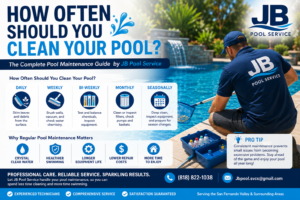
The best equipment repair is the one that never has to happen. Preventive maintenance — regular inspections, cleanings, and tune-ups — extends the life of your equipment and prevents the kind of failures that leave you without a working pool in the middle of summer.
JB Pool Service includes equipment inspection with every regular service visit. We also offer dedicated equipment service appointments for annual tune-ups, pre-season checks, and post-installation inspections.
Signs it’s time for a professional equipment inspection:
- You haven’t had your equipment professionally inspected in over a year
- Your energy bills have increased without a change in usage
- Equipment is making sounds it didn’t used to make
- Water chemistry is hard to maintain despite proper chemical dosing
- You’re adding chemicals more frequently than usual
Why Southern California Pool Owners Trust JB Pool Service
Since 2010, JB Pool Service has built a reputation for professional, reliable pool equipment service across Southern California. Our technicians are experienced with all major equipment brands, trained on current technology, and committed to giving every client an honest assessment and quality work.
We don’t cut corners. We don’t recommend work that isn’t needed. And we stand behind every installation and repair we perform.
Get a free estimate for pool equipment installation, repair, or maintenance.
📞 Call Us | jbpoolservices.co ⭐ Professional Pool Care Since 2010
JB Pool Service specializes in pool equipment installation, repair, and maintenance for residential and commercial pools in Southern California. From variable-speed pump installations to heater repairs and automation upgrades — we keep your equipment running perfectly.