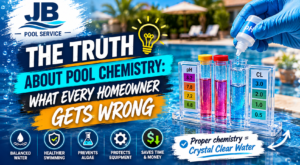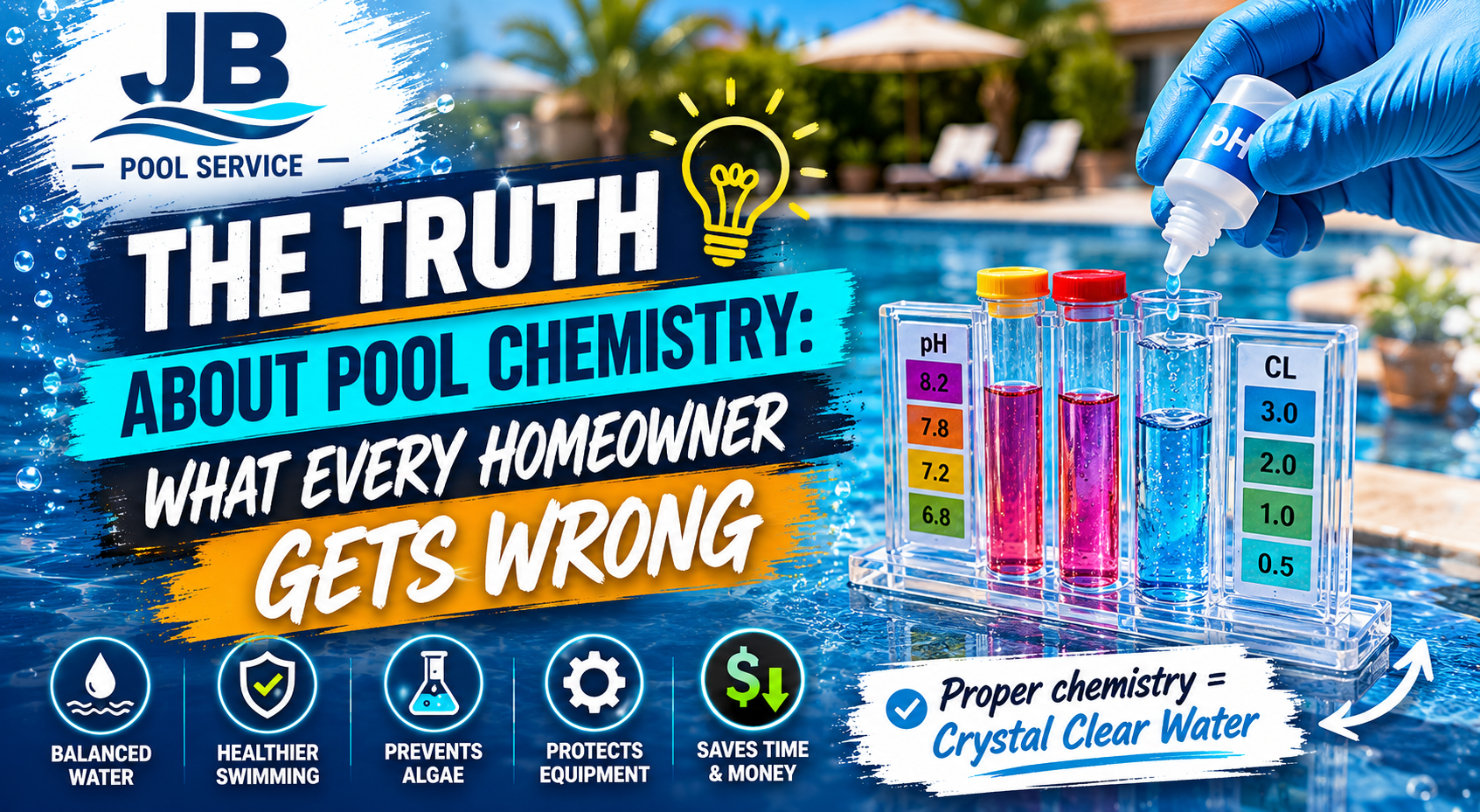
The Truth About Pool Chemistry: What Every Homeowner Gets Wrong
Chlorine is just one piece of the puzzle — here’s the full picture.
Most pool owners think about pool chemistry only when something goes wrong — the water turns green, their eyes sting, or a swimsuit fades after a single dip. The truth is, balanced pool water is a result of managing several interconnected chemical parameters, not just dumping in chlorine and hoping for the best. After 15-plus years of service calls, the JB Pool Service team has seen every chemistry mistake in the book. Here are the most common ones — and how to avoid them.
Mistake #1: Relying Only on Chlorine Tablets
Trichlor tablets are convenient, but they continuously lower your pool’s pH and add cyanuric acid (CYA) to the water with every dissolve. Over a season, CYA levels can climb so high that they actually neutralize your chlorine’s ability to sanitize — a phenomenon called “chlorine lock.” The fix is usually a partial drain and refill, which is far more work than a simple routine balance check would have prevented.
Mistake #2: Ignoring Total Alkalinity
pH gets all the attention, but total alkalinity (TA) is what stabilizes it. Think of TA as a buffer: without adequate alkalinity (ideally 80–120 ppm), your pH will swing wildly up and down in response to rain, swimmers, and added chemicals. A pool with erratic pH is corrosive to equipment, rough on skin, and nearly impossible to keep clear.
The Langelier Saturation Index
Professionals use the LSI — a formula that combines pH, alkalinity, calcium hardness, temperature, and TDS — to determine whether water is truly balanced. When the LSI is off, water either etches plaster and corrodes metal (too aggressive) or deposits calcium scale on surfaces and equipment (too saturated). Our techs check this on every visit.
Mistake #3: Shocking at the Wrong Time
Adding shock (unstabilized chlorine) during daylight hours is largely a waste. Sunlight burns off free chlorine rapidly — up to 1 ppm per hour in direct California sun. Always shock your pool in the evening or at night, and run the pump for at least 8 hours afterward to fully circulate and dissolve the oxidizer throughout the water.
Mistake #4: Over-Stabilizing with Cyanuric Acid
CYA protects chlorine from UV degradation, which is genuinely useful in sunny climates. But the ideal range is 30–50 ppm. Once you’re above 80–100 ppm, your effective chlorine level drops dramatically even if the test strip reads fine. High CYA is one of the most underdiagnosed causes of persistent algae problems we encounter.
Mistake #5: Testing Infrequently
Strip tests done once a week give you a snapshot, but pool chemistry changes daily — influenced by temperature, rain, bather load, and even windblown debris. Professional-grade liquid reagent testing (what we use) is far more accurate than strips, and we test every parameter on every visit: free and total chlorine, pH, alkalinity, calcium hardness, CYA, and TDS.
~ ~ ~
The good news is that you don’t have to become a chemistry expert to enjoy a clean, safe pool. That’s exactly what a professional maintenance program is for. When JB Pool Service handles your weekly service, chemistry is dialed in before problems have a chance to develop.
Stop guessing at your water chemistry.
Our weekly service plans include professional-grade water testing and balancing every visit. Get crystal-clear water without the headache — call us for a free estimate today.
Phone: (818) 822-1038
Email: Jbpool.svcs@gmail.com